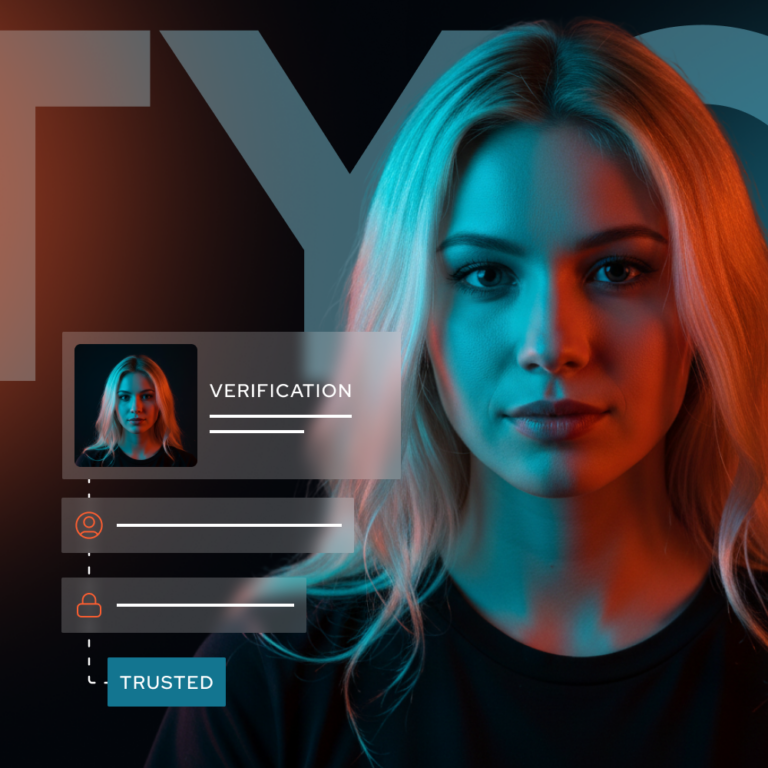
Trust Your Customer (TYC) represents a fundamental shift in how organisations approach identity verification. In our previous article, “From KYC to TYC: What Changes, and Why It Matters“, we established the problem: KYC alone is no longer sufficient, and TYC represents a fundamentally different way of thinking about trust. Now it is time to go deeper.
TYC is not a single technology or a plug-in solution. It is a philosophy of continuous trust, operationalised through a set of interconnected capabilities that work together across the full customer lifecycle.
At its core, TYC rests on three pillars: compliance without compromise, real-time fraud defence, and seamless customer experience. Each addresses a distinct dimension of the challenge. Together, they form a complete framework for identity assurance in the modern digital economy.
Pillar 1: Continuous Compliance Without Added Friction
The dominant response to rising regulatory pressure has been to add controls. More manual reviews. Stricter rules. Heavier oversight. The logic is understandable: if regulators want more assurance, provide more checkpoints.
But this approach has a cost. Heavier controls mean slower journeys, higher operational overhead, and frustrated customers, without necessarily delivering better regulatory outcomes. More friction does not automatically mean stronger compliance.
TYC offers a different model: compliance as a continuous state, not a series of checkpoints.
Proactive rather than reactive
In a TYC framework, issues are detected and addressed as risk signals emerge, not during post-incident reviews or periodic audits. Compliance teams are no longer playing catch-up. They are working with live signals that reflect the current state of each customer relationship.
Traceable rather than tribal
Every step-up, every flag, every intervention can be tied to specific signals, policies, and verification steps. The logic of the decision is documented and reproducible. There is no reliance on institutional memory or individual judgment calls that cannot be explained or audited.
Defensible rather than debatable
When a regulator asks why a particular step-up happened or why it did not, the organisation can answer clearly, with evidence. The compliance posture is robust precisely because it is continuous, not periodic.
This is what compliance without compromise means in a TYC framework: stronger assurance, delivered with less blunt-force friction. The controls are more targeted. The documentation is more complete. And the regulatory posture is more resilient.
Pillar 2: Real-Time Fraud Defence
AI did not only accelerate productivity. It also accelerated crime. The economics of fraud have shifted dramatically. Synthetic identities, deepfakes, social engineering, and automation-driven account attacks are no longer the preserve of sophisticated criminal networks. They are increasingly accessible, scalable, and effective.
The old model of static rules applied at onboarding, supplemented by periodic reviews, creates blind spots that sophisticated attackers can probe systematically. If the rules are fixed, they can be reverse engineered. If reviews are periodic, the window between them is an opportunity.
TYC closes those blind spots by treating fraud defence as a perpetual, adaptive process.
Identity monitoring across the full lifecycle
Under TYC, identity is not only verified at the door. It is monitored and re-evaluated whenever risk indicators shift, across every interaction, every channel, and every touchpoint.
Risk-based orchestration
Customers are routed through different verification paths depending on context, behavioural signals, device signals, and transactional patterns. The system adapts to what is actually happening, not to a fixed rulebook written months ago.
Step-up verification as a precision tool
Step-up verification is applied when the risk warrants it, and invisible when it does not. The goal is not to verify more, but to verify smarter. To intervene at the moments that genuinely matter, with the level of assurance proportionate to the risk.
Because the costliest fraud attack is often the one that happens months after onboarding, when an already-verified account is hijacked, manipulated, or quietly repurposed.
Pillar 3: Seamless Customer Experience Without Compromising Security
Security teams have long operated under a perceived trade-off: reduce risk or reduce friction. Tighten controls, and customers complain. Smooth the journey, and you expose the business. In practice, both extremes are untenable, and neither is necessary.
TYC breaks this trade-off by aligning verification intensity with real-time risk.
When risk is low
The customer is behaving consistently, on a recognised device, in a familiar context. The experience is fast, minimal, and almost invisible. No unnecessary steps, no redundant checks.
When risk rises
An unusual pattern emerges, a new device appears, or a high-value transaction is initiated. A targeted, explainable step-up is introduced. The intervention is proportionate to the signal. The customer understands why it is happening. And the business has a clear record of why it occurred.
When risk is high
Stronger measures are applied, with clear rationale and documented evidence. Whether the signal is an account takeover attempt, a synthetic identity indicator, or a suspicious beneficiary addition, the response is calibrated, not blunt.
Customers accept friction when it is relevant and contextual. What they resent, and what drives drop-off and churn, is friction that feels random, excessive, or unexplained. TYC eliminates the second kind without compromising protection against the first.
Why TYC Is a Competitive Advantage for Digital Businesses
It is tempting to frame TYC purely as a risk and compliance story. But its implications extend well beyond the risk team.
In the digital economy, trust is growth infrastructure. When customers feel safe and unblocked, they complete journeys. They adopt new features. They stay. Conversion rates improve. Lifetime value increases. Churn decreases.
At the same time, regulators gain confidence that controls are proportionate, monitored, and well-governed. The compliance conversation shifts from defensive justification to proactive demonstration.
And operationally, the move to continuous, risk-based assurance reduces the cost of manual reviews and the inefficiency of blunt-force controls. Fewer false positives. More targeted interventions. Better use of compliance resources.
Trust Your Customer, in this sense, is not just a better way to manage identity risk. It is a better way to run a digital business.
The Future of Identity Verification: Continuous Trust
KYC will always matter. It is the starting gate, the essential first step in establishing who a customer is. But in a world where risk evolves between clicks, where fraud adapts faster than static rules can respond, and where regulators expect continuous assurance rather than periodic snapshots, it cannot be the finish line.
Trust Your Customer is how organisations move beyond knowing. It is how they maintain confidence in who is behind the screen, not just at onboarding, but across every interaction, every channel, and every moment of risk.
Know customers at onboarding, because you must. Trust customers over time, because you can.
The future belongs to the institutions that build the infrastructure to do both. Ready to explore what that looks like in practice? Discover how IDnow helps organisations make the shift from KYC to TYC.
By

Mallaury Marie
Campaign Manager at IDnow
Connect with Mallaury on LinkedIn